

Last year, I wrote an article for Home for Good on how our churches can support single adopters and foster carers.
It was generally well-received, but one commenter asked – and I’m pleased he did – whether adoption was something we should be encouraging for the single brothers and sisters in our church communities. After all, he said, as a church leader he wouldn’t advise a single woman to undergo IVF, so was there any difference?
He wasn’t being offensive or argumentative. He was simply wondering aloud, acknowledging – after considerable theological study – whether there might potentially be some discord between the Bible’s understanding of children being brought up by two parents, and our culture’s understanding of the ‘right’ of any adult human to have a child, regardless of marital status.
I’m so glad he brought this up, because I know that too often I’m automatically swept along by the culture (read: social media), without even running things through the filter of the Bible. Instead of filtering our culture through the Bible, we filter the Bible through Twitter. And that’s just not a healthy way of doing things.
There is, of course, an element of cultural understanding when trying to apply the Bible to our lives – after all, many of the battles we face today weren’t around at the time the Bible was written. But that doesn’t mean we should make up our mind about an issue, then work the Bible round it.
So, in this case, should single Christians adopt?
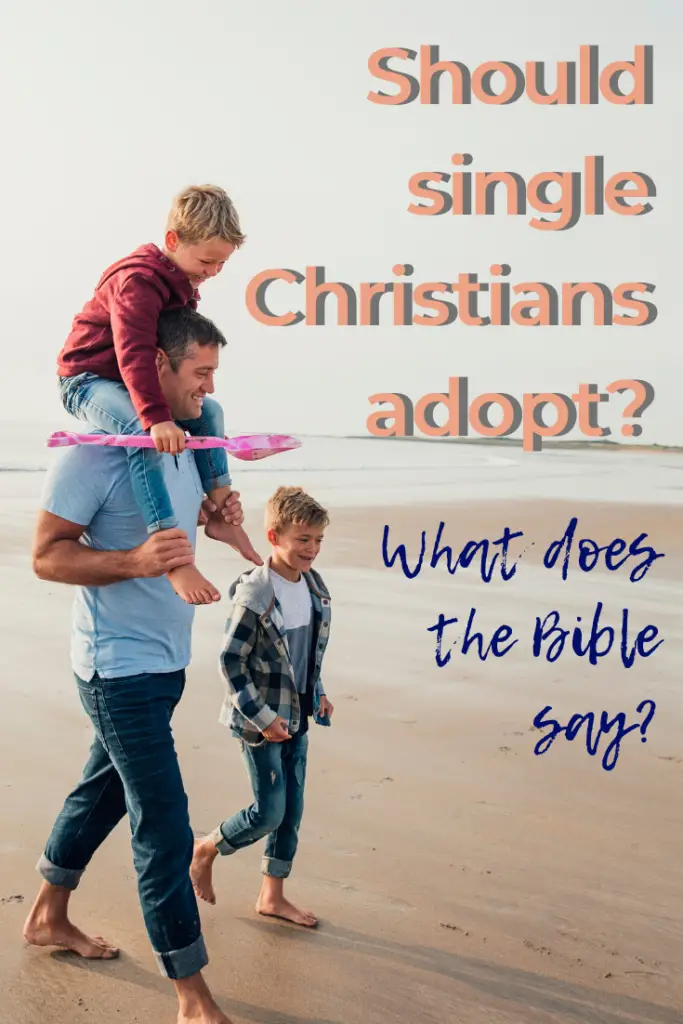
A willing single parent
Around ten years ago, I was pretty surprised when a single friend of mine declared that if she hadn’t found a husband by a certain age, then she would apply to adopt as a single person.
I think my shock came from simply not knowing anyone who had done this before (it’s a lot more common now, and also I know more adopters!). I asked my friend whether she felt that the Biblical model of parenthood was mum-and-dad together, and she responded with yes, she did believe that, but that there were plenty of less-than-perfect parenting situations around, including those with two parents. She felt that God understood the brokenness of families, and would rather children be raised by a stable, single person than no one at all.
My friend gave me a lot to think about, before we’d even considered adoption for ourselves, for which I’m grateful. Although she later met and married her husband, and had children with him, the passion God put in her for adoption has been realised, in part, by becoming godmother to our Monkey, who is adopted.
My views have changed
A decade down the line, and I’ve given this matter some serious thought. I’ve done a whole load of reading and writing on adoption. I’ve written Bible reading notes on the subject. I’ve met a huge number of adopters and foster carers, of all faiths and none, in person and online.
I’ve come to the conclusion that single adoption is not only acceptable, it’s a faith-filled, Biblical model which has the potential to teach the whole church family something important about God’s sacrificial love for each one of us.
A Biblical command to multiply
How have I come to this conclusion? I’m going to start by stepping back from this question, to get a broader Biblical view of what God asks of us when it comes to children generally.
Firstly, God commands us as a human race to multiply, increase in number, fill the earth. He gives this command to the first ‘married’ couple, Adam and Eve (Genesis 1:28) and again to Noah, his wife, their sons and their wives after the flood (Genesis 9:7).
Unlike our 21st-century way of thinking of parenthood as a ‘right’, in the Bible it is a commandment, a model of self-sacrificial worship as we battle the sleepless nights and lack of time for ourselves, in honour of the God who has asked us to keep His human race going.
This is not to say that parenthood can’t also be incredibly fulfilling, nor the thought of it painfully difficult for those who are dealing with infertility. After all, our desire to procreate and give ourselves up for the lives of our children is entirely God-given.
But the primary reason we have children naturally is not to fulfil our own need to be a parent, but for the good of our communities and, above all, to honour God.
In other words, while it is not specifically outlined in this way (although implied in places like Ephesians 6:1-4), birth children are ideally raised in a family which includes mum and dad.
But, of course, we’re an imperfect people and life doesn’t always work out so well. Through death or desertion, children will not always be able to be raised by their biological parents, so God gives an additional, very different commandment – to care for vulnerable children.
A Biblical command to care
In the Bible, this commandment to care for orphans is never aligned with the commandment to fill the earth – in other words, it is not a commandment given specifically to married couples. So who is it addressed to?
Initially, it is addressed to the Israelites as a community. In Deuteronomy, for example, when God is giving the Law to His people, the word ‘fatherless’ appears eleven times. The Israelites are told, “Do not deprive the foreigner or the fatherless of justice” (Deuteronomy 24:17).
This is supported in the New Testament, when James writes – again to a community rather than an individual or couple – “Religion that God our Father accepts as pure and faultless is this: to look after orphans and widows in their distress and to keep oneself from being polluted by the world.” (James 1:27)
The crucial difference here is that while the command to multiply is given to married couples, the command to care is given to the entire community.
God has a particular concern for those who have very little, and when we care for them, we glorify Him by expressing an essential aspect of His character.
But there are many ways to fulfil this commandment. David fulfilled it by ensuring that Mephibosheth, disabled and disempowered by the culture, would always be provided for (2 Samuel 9). Job fulfilled it by ensuring legal representation for those with no voice (Job 29). And Joseph fulfilled it by adopting Jesus, and raising him as if he were his own flesh and blood (Matthew 1:18-25).
We might fulfil this commandment through prayer, financial giving, or supporting families we know. But let’s not forget that, in today’s culture, vulnerable children need forever families. And some of us will be called to physically provide them.
Adoption is ‘Parenting-With-Extras’
I’m not saying that adopting is simply ‘care-giving’, whilst biological parenting is ‘proper’ parenting – definitely not. When we adopt or foster, we become parents in the fullest sense, raising, teaching and nurturing our children, regardless of whose womb they inhabited.
(Check out Dear World: My ‘adopted’ children are also my ‘own’ children – please don’t differentiate for my strong views on this!)
The distinction I believe the Bible makes has more to do with who can offer what is being required. Married couples can offer a continuation of the human race. Adoptive parents can offer a safe, loving, stable home for a child who needs one.
Adoption is full parenthood – but it is not merely parenthood. It comes with the additional complexities of a child who has experienced trauma in early life.
In God’s strength, a single adoptive parent acts as both Mum and Dad to her child. She spends years parenting a traumatised son or daughter with patience, compassion and empathy. She never stops advocating for her child when none of the professionals are listening. She is not afraid to go through hard times with her child who has had a rough start to life. She sacrifices her social life, her church involvement, her job and sometimes even the possibility of a marriage partner – all to fulfil God’s command to care for the vulnerable.
A single Christian adopter does not adopt out of a selfish desire to become a parent at any cost, but with a willingness to pour himself out on behalf of another. In doing so, he reflects Jesus, who poured himself out for us before we’d even turned to him for help.
A challenge for all of us
The call to look after vulnerable children is addressed to us as a community, both in Deuteronomy and in James. So if we know someone who is adopting and fostering (single or otherwise), the onus is on us to wrap around them with care and support.
When we are talking adoption or fostering, it shouldn’t make a big difference whether the parents themselves are married or single – if they’re Christians, then their church community should be sharing their burdens and their joys alongside them.
‘It takes a village to raise a child,’ as the old proverb goes. God has always been calling communities to take seriously the job of caring for children, but particularly when the child cannot live with his birth family.
None of us can raise children on our own – we weren’t meant to. Married couples with children, whether biological or adopted (or both, in a blended family set-up), need the support of their church family. Single parents with children, whether biological, adopted or both, also need our support.
>>How Post-Adoption Support Gave Us Hope<<
Over to you…
What I am learning is that God’s call to care for the vulnerable is not restricted to certain types of people, and it’s certainly not restricted to people based on their marital status. Single adopters are to be encouraged and affirmed in the part they’re playing in God’s Kingdom.
Maybe God is calling you to care for a vulnerable child through adopting or fostering – or to support someone who already does this. Home for Good is a great place to start if so.
And I write regularly about adoption, parenting and faith on this blog, so sign up to hear about new articles, as well as gain access to my VIP Library of free e-books and printables to support you in your parenting.
